An online store that sells art prints wrote to me in March of last year. It was ranking on Google. It had "zero orders." The only recent sale was a print one of its owners bought, to check that the checkout worked.
It did work. Nobody else had used it.
If you have ever said "we tried it for a month and it did not work," you are not being impatient, and you did nothing wrong by asking. Here is the short answer. A month is too soon to judge the traffic. It is long enough to see whether anyone built the things that make a sale. You don't need a report to check that. You can see it for yourself, and this post shows you how.
That business did not try it for a month. They gave it more than a year. So this is not a post about being patient. It is about the two very different things people mean when they say "we tried it for a month and it did not work."
Is a month too soon to judge?
When an owner says that, they mean one of two things.
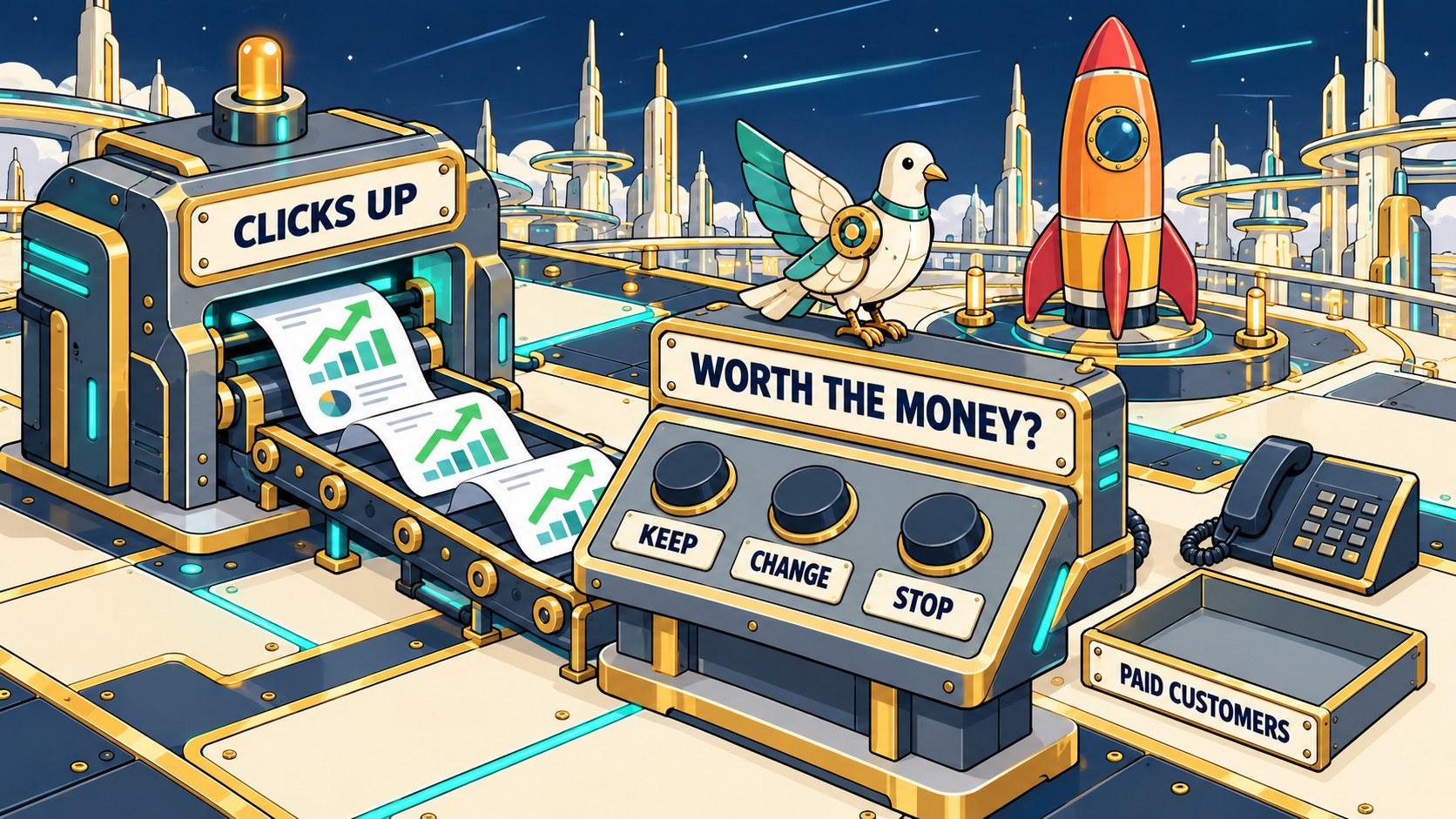
The first one: "I paid for a month, and the phone did not ring more." That may be too soon to judge. Free search traffic grows slowly. I wrote a whole post on how long each part of marketing really takes, and the honest answer depends on which job you paid for.
The second one: "I paid for a month, and I can't see anything that was built." That is not too soon. A month is plenty of time to see whether the work is aimed at a sale.
In September 2026 I searched three ways an owner might ask this question online, such as "we tried SEO for a month and it didn't work." Of the 27 results, 21 came from marketing agencies, the people who sell the work. So most of the advice you will find on this question comes from the person being paid, about the patience of the person paying.
A report that says you are easy to find, and a bill that keeps you paying. Neither one takes a sale.
So here is the other side. I will spell out what it actually takes to rank and what it takes to sell. Then I will show you two real stores I worked with, and how one of them turned around. Then you can check your own month.
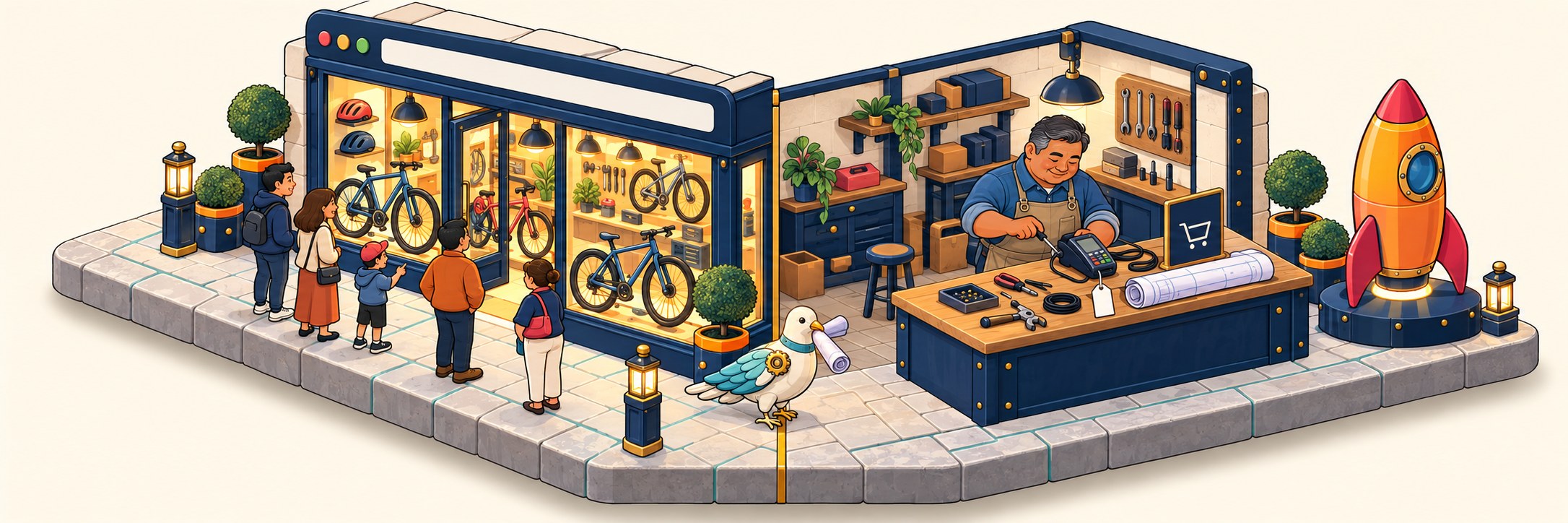
Picture a shop on a busy street with its sign lit and its windows bright, so people walk in because they can see it from the road.
Now picture the same shop with no till: no card reader, no prices, and nobody at the counter. People look around, pick things up, and leave.
Ranking on Google turns the lights on. It brings people to the counter. A sale needs a till, a price, and someone to take the money. A ranking report shows you the lights. It does not show you the till.
A month is too short to see the street get busy. It is long enough to see whether anyone is building a till.
What does it actually take to rank?
This is the part most people skip, so I will go slowly. Each of these is a real piece of work. For each one, I will say what you should be able to see after thirty days.
Google has to be able to read your pages
Google sends a program to read your site. Google's own guide to how Search works calls it Googlebot. The same guide says some pages are blocked from it, and that "indexing isn't guaranteed; not every page that Google processes will be indexed." A page that is not in Google's index can't show up in a search.
Broken links are the most common version of this. A link points to a page that is gone, and the reader gets an error. One shop I worked with had a site-health tool that kept flagging broken links, week after week. Every one of those is a dead end, for a reader and for Google.
By the end of the first month, whoever is doing the work should be able to show you which pages Google reads and which it misses, with the broken ones fixed or on a dated list. You can check it yourself for free. Google Search Console has a Page indexing report that, in Google's words, "shows how many URLs on your site have been crawled and indexed by Google."
You have to rank for what buyers type
Here is a mistake I have made on my own site. You can rank well for a search that never turns into money.
My own post on "what is a website" is the page Google shows most on my whole site. In the ninety days to August 25, 2026, Google showed it 1,489 times, and it got zero clicks. People searching that want a definition, not a web consultant. The search is real, but the buyer is not in it.
The searches that pay are the ones a buyer types when they already have the problem. Compare "engraved retirement gift near me" with "how does laser engraving work." The first person is shopping and the second is probably just curious. Both searches can rank, but only one is likely to fill the till.
Ask for the list of searches the work is aimed at, with a reason each one belongs to a buyer. If nobody can hand you that list a month in, nobody chose it.
Your tracking has to count once
If you count something twice, the reports built on that count are wrong.
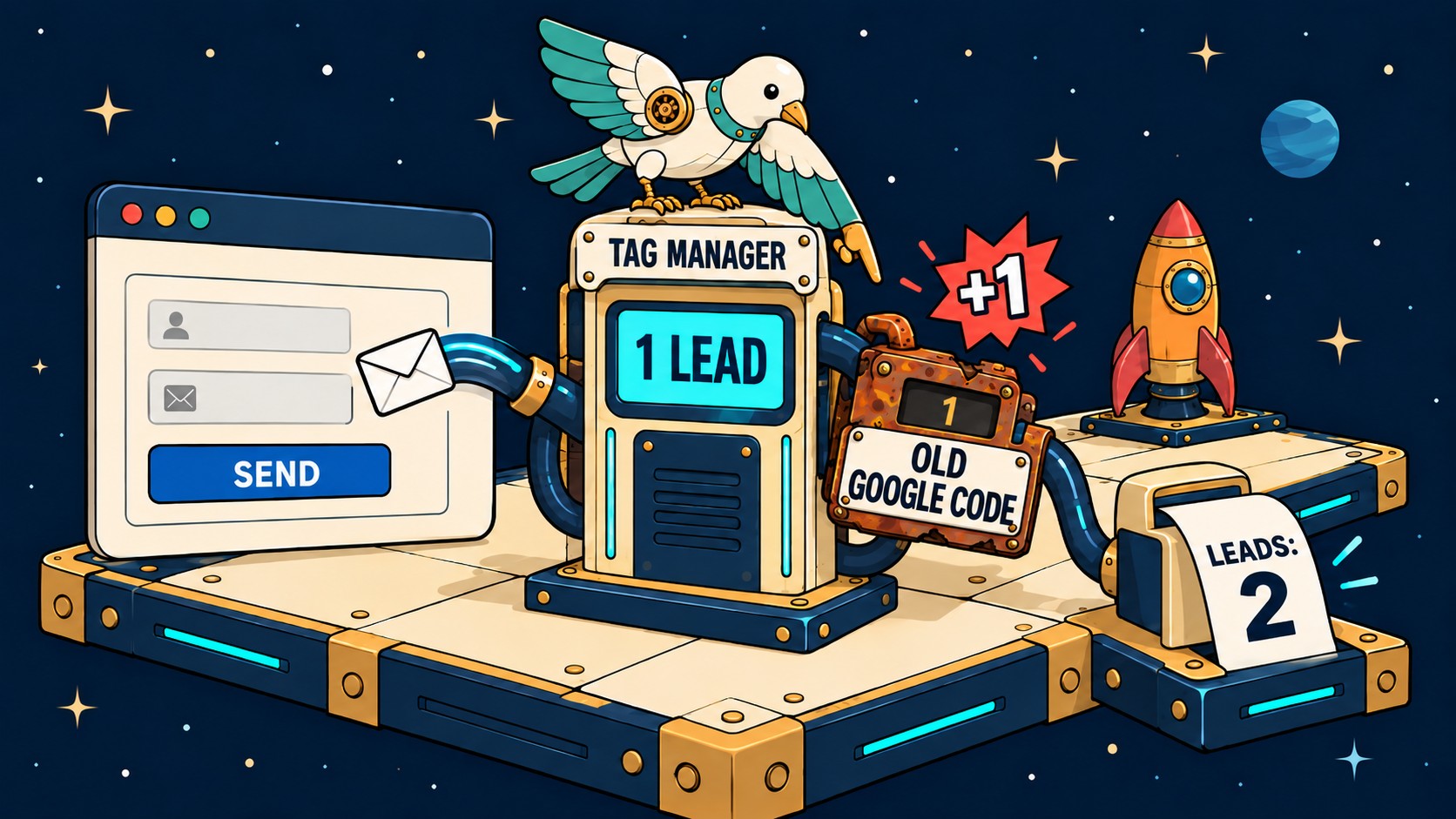
In June 2024 I sent an owner an email about exactly this. Their site had "multiple installations of Google Analytics, including Universal Analytics." Google's own help pages explain why that matters: "A single user action ... can be counted more than once if you have multiple Google tags set up," and "duplicate tags can cause inaccurate report data." (Google Merchant Center Help.) You can't judge a month of work with a ruler that stretches.
Two copies of the same tracking code count one click twice. Taking the copy down fixes the report.
If you serve a local area, your listing has to be right
For a plumber, a salon, or a shop with a door, the Google map listing is its own piece of work. Google's page on improving your local ranking says local results are based on relevance, distance, and prominence. It says "businesses with complete and accurate info are more likely to show up in local search results," and that "more reviews and positive ratings can help your business's local ranking." So the listing needs the right name, hours, phone number, and service area, and it needs reviews.
A month is plenty of time to go through the listing line by line, fix what is wrong, and start asking happy customers for reviews in a way your staff can keep doing on a normal Tuesday.
Other sites have to point to yours
Links matter too. On that same local ranking page, Google says prominence is based partly on "how many websites link to your business." This is the slow part. A local paper, a trade group, a supplier, or a partner can each help. Buying links is not a shortcut. Google's spam policies list "buying or selling links for ranking purposes" as link spam.
What you want early on is a short list of real places that could link to you and why each one fits, not a report of hundreds of links from sites you have never heard of.
Each cable is a real local site linking to the shop. The pile of cheap wires is bought links, which Google calls spam.
This is where the patient answer is right. When the pieces above are done well, the growth still takes months. One remodeler I work with went from about 120 showings a month on Google to about 6,690 over twelve months, as I showed in how long till my website sees results. That did not happen in month one. It happened because month one built the right things.
What does it actually take to sell?
Ranking gets people to the counter. This part is the till, and it is the part a ranking report never shows.
There has to be a way to pay that works
For a store, this means the checkout works on a phone and on a computer, with every normal card. It also means your products can show up where shoppers compare prices. Google's page on free listings says that with one, "the products you sell can appear at no cost on Google Search, Google Maps, Gemini, YouTube, the Shopping tab, Google Images, and Google Lens." To get there you need a Merchant Center account and your product details loaded into it. Google also says this "doesn't guarantee that your products will be shown."
She loads her product details once, and her print shows up where shoppers compare prices.
The proof here is simple. Someone places a test order or sends a test form while you watch, and it arrives. If you sell products, Merchant Center should be set up by now, or have a date.
The page has to answer the questions a buyer has
Look at your best page the way a buyer would. Is the price there, or at least a range? Can you see the real work? For an art print, that is the print on a real wall at a real size. For an engraver, it is a close photo of the finished piece. For a remodeler, it is the actual bathroom, before and after.
Start with the page that sells the work that makes you the most money, and fix that one before anything else.
Not everyone who starts to buy finishes. At the art-print store below, people added a print to their cart 37 times over fifteen months, and there were 10 orders. Following up by email, text, or a phone call is how a business gives the rest a second chance.
So ask one plain question about your own business: what happens to someone who asks about a job and does not buy? If the honest answer is "nothing," you have found where sales slip away.
The art-print store, all of it
Here is the whole story, because the short version leaves out the part that matters.
We started in January 2024. By August we had delivered the search terms the store was aiming for. The pitch was that the store would sit near the top of page one, "just below Walmart but above Etsy."
By March 2025 the store was ranking. We counted 25 search terms where it showed up on Google, and 5 on the first page. By the measure in our own reports, the work was going well.
By the owner's measure, it had failed. There were no orders. They wrote that they "had sales before we engaged this work." The one sale was the owner testing the store's own checkout.
When I went back through it, one thing stood out. Merchant Center had never been set up. The store could be found. Its products could not show up where shoppers compare prices. The lights were on. The till was not wired to them yet.
That store was on page one of Google for five searches, and its only recent sale was to one of its own owners. Ranking alone was never going to fix that.
I looked at the store's numbers again this month. It is selling now.
The checkout that once took one test order from one of its owners now takes real orders. Since late June 2025, the store has sold 20 prints, and six of its ten orders came this year, up 20 percent on the period before. Every sale now shows up in its reports, so the owners can see which links and searches bring buyers.
Here is the part I want to be honest about. Google search did bring in buyers, but not most of them. Most of the money came from people who clicked a link the store shared on Facebook, and a few from LinkedIn, then bought.
That does not make the search work worthless. People still find the store that way, and they read the pages. But it proves the point of this whole post. Ranking turned the lights on. The sales came when the till worked and the owner sent the people who already loved the work straight to it.
The second one is a small shop that engraves gifts and signs with a laser.
For months, the site-health tool sent the same weekly warning about broken links. In June 2024 I wrote to them about their tracking. The site had more than one Google Analytics setup running at once, so its numbers could not be trusted. And the site ranked for 21 search terms, with none of them on the first page. For contrast, I pointed out a barbershop I worked with that ranked for more than 4,000.
The short version: the lights were dim, the ruler was bent, and no report could be trusted until those two were fixed.
The time I was wrong about my own site
It would be easy to write this post as if I always know which case I am in. I don't.
While writing a different post, I checked the eight contact forms on my own website. Seven were set up one way. One was set up another way, a way I knew was wrong. I built a whole explanation out of that one fact.
Then I ran the first step of my own checklist. I filled in the form myself, with a code in it so I could find it. It arrived in eighty-seven seconds. My explanation was wrong. I told that story in full in nothing changed but the leads stopped.
The lesson carries over here. Before you decide that a month of work failed, run the test. Before you decide it is too soon to judge, run the test too.
When should you stop paying?
This is the part I would rather not write, because it costs me work.
If a month in you can't see any of the things above being built, stop paying for patience. That includes paying me. Patience is for work that is aimed at a sale and needs time to grow. It is not for work that has no till.
Here is how to tell which you have:
- It is too soon if you can see the pieces being built, each has a date, and only the traffic is missing.
- It is the wrong thing if nobody can show you the buyer searches, the tracking test, the checkout test, or the follow-up. Then more months will buy more of the same.
- It is both if some pieces are real and some are missing. Then keep the real ones and fix or drop the rest.
The four things to ask for: the buyer word list, one test counted once, a test order that arrives, and a follow-up plan.
A good consultant will tell you which one it is, even when the answer means a smaller bill. If you are not sure which one you have, ask me to look at yours.
Answer all eight first. Then, on the TRUE cards, tap the ones that really happened in your first month, not the ones you were told about. The box at the bottom tells you which case you are in.
The day 30 check, on one page
Questions people ask about quitting too early
How long should I give SEO before I stop?
Long enough to see the pieces built, which is about a month. The traffic itself takes longer. I went through the studies on that in how long till my website sees results. Judge the first month on what was built, not on how much the phone rang.
Is one month of ads enough to judge?
It is often enough to see whether the ads are aimed at buyers and whether the tracking counts each sale once. Judging the final cost per customer can take longer. Google's own page on the learning period says a bid strategy can take "a few conversion cycles (1-2 typically)" to adjust after a change.
What should I ask my marketing person after thirty days?
Ask them to show you four things. The buyer searches they chose. A test of your tracking. A test of your checkout or form. What happens to someone who asks a question and does not buy.
Why did my site rank but not sell?
Usually because the till was never built. The checkout, the price, the photos, the follow-up, or a shopping account like Merchant Center is missing. Ranking brings people in. Something else has to take the money.
Can I check any of this myself?
Yes. Fill in your own form. Buy something small from your own store. Search for what a buyer would type and see what comes up. Each takes a few minutes and costs almost nothing.
If you want someone to look at your own month and tell you which case you are in, request a free site analysis. I will tell you if it is too soon, and I will tell you if it is the wrong thing.














 Readable pages
 Counted once
 Map listing
 Real local links
 Test order arrives
 Calls answered
 Price shown
 Products listed
 Follow-up plan