Spring Hill KS, 66083

- Home
- > Digital Marketing Services
- > Web Design and Development
Web Design and Development
The launch email went out on a Friday. Three months later, on a Tuesday, a customer mentions she filled in your contact form twice and nobody answered. The site looks fine. It has looked fine the whole time.
That Tuesday is what I build for. A website is not a launch. It is a thing that has to keep working when nobody is watching it: the form has to reach a person, the numbers have to be wired before go-live, the logins have to be in your name, and somebody has to check it every month. This page is about that, for businesses in the Kansas City metro: Spring Hill, Olathe, Overland Park and the neighborhoods between.

Two forms, one Tuesday
In August 2026 two live contact forms on a nonprofit's site returned "sent" on every submission. Not one of them arrived. There was no bounce, the automatic notice that a message failed, nothing in a spam folder, no trace. The site's own server was sending the mail as if it came from a Gmail address, and Gmail's rules reject exactly that. A third form, built three days earlier, delivered every test. That third form is the control: the site was fine, the forms were not, and nothing on the screen could tell you which was which.
The other shape of the same Tuesday: in 2018 a site I had set up was handed to its host and went live. The owner wrote within the hour that three large orders had already come in. The difference between those two stories is not the design. It is whether anyone tested the path from the form to a human before the launch email went out.
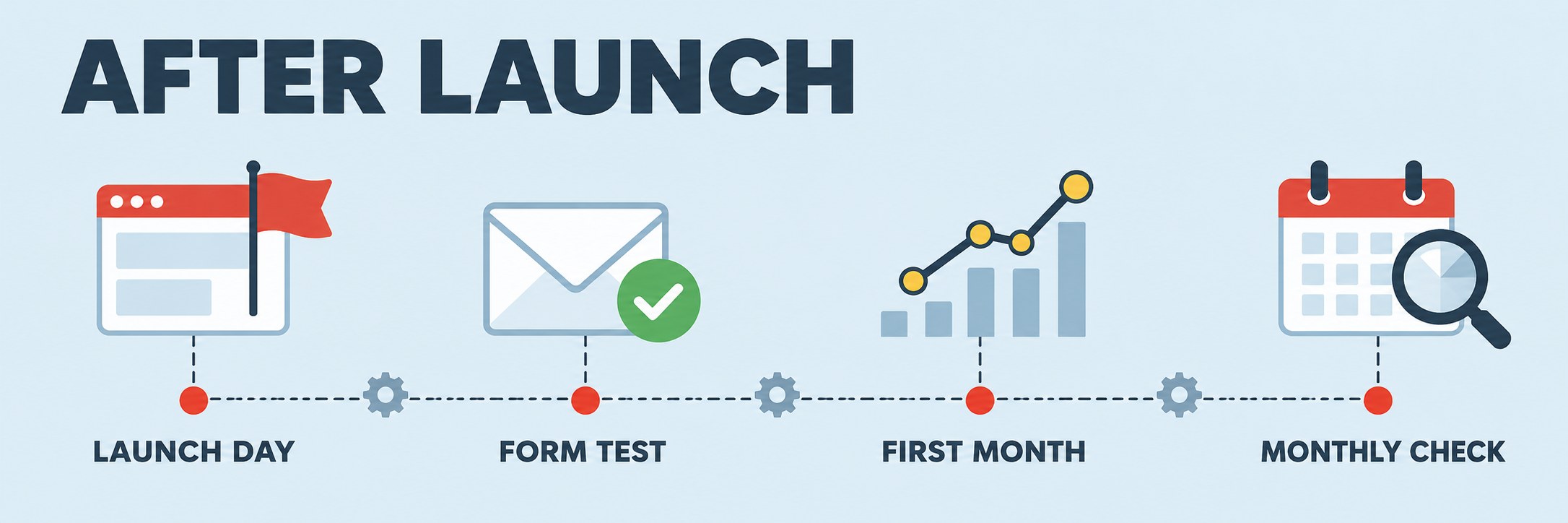
So every form I ship is tested end to end with a control, a submission that must arrive, and one that must not, and the test is repeated after launch. That is the whole reason this page exists.
A nonprofit's site, August 2026 · what its own contact forms did
2
live contact forms that said "sent" on every submission
0
of those submissions delivered, with no bounce and no trace
1
control form, built three days earlier, delivered every test
3 days
between the form that worked and the two that did not
Source: the site's mail server and Gmail's own rejection rule, read 2026-08-26. The screen said sent. The inbox said nothing.
Nothing changed, and the site changed anyway
Two records from sites nobody was touching.
First, a legacy client's site went from 24 error pages to 435 in one week. The same alerts counted 492 images with no alt text and 22 pages with no headline. Nobody had changed anything on purpose. Something had updated, and the site rebuilt itself around it.
Nobody Touched It
A legacy client's site, June to August 2026 · what the weekly crawl alerts counted
24 → 435
error pages, in one week
492
images with no alt text
22
pages with no headline
0
changes made on purpose by anyone
Source: the crawler's weekly alert mail, three threads, read 2026. Something updated, and the site rebuilt itself around it.

Second, a retailer's site did 703 clicks on 69,500 impressions in one month, and then a new reason appeared in Search Console: blocked by robots.txt. Its plugins were updating themselves every night. Weekly mail about broken links and an outdated script library had been arriving for months. Nobody touched the site. Things changed anyway.
A site that nobody checks does not stay the way it was launched. That is why a monthly check is part of the work and not an add-on.
Web design is not what you need if
You need a tune-up, not a designer
If the site loads, the form delivers and the copy is yours, a redesign is the expensive way to fix a small thing. Whether you need a tune-up, a refresh or a rebuild is a decision, and Do you really need a new website? walks it through with the costs.
You have no content or photos yet
A designer cannot fix an empty site. I audited a shop whose blog lived at an address full of question marks, with comment spam showing and not one photo of the work they do. Thirty photos of the craft and a page of plain text about what you do come before any design, and I will say so.
Your site is fine and the leak is the handoff
If the form delivers and the lead still goes cold, the problem is what happens after the form: who gets the email, and how fast. That is the lead handoff nobody owns, not a new site.
The honest answer for all three is to spend the money somewhere else first. Ask me and I will say so.
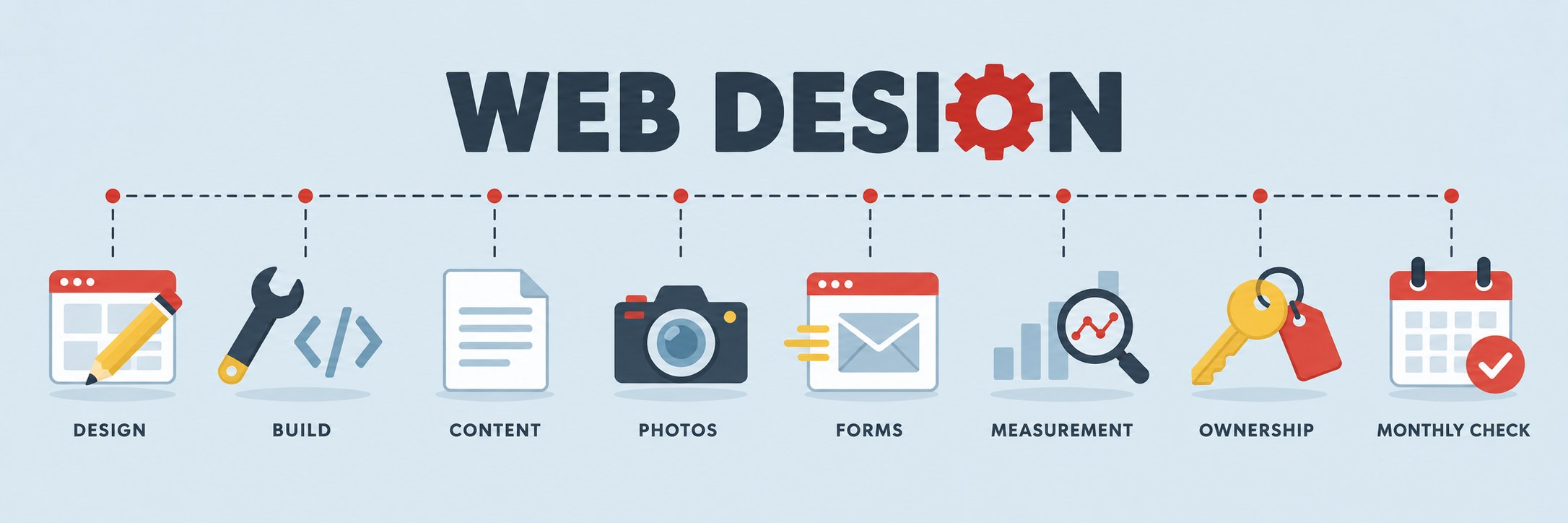
Web Design Services

Design and build
A site on a platform you can log into, with the pages your customers use, built to load fast on a phone. Kansas City businesses mostly need five to ten pages done properly, not fifty.

Content and photo plan
A page of plain text and thirty photos of the work, gathered before design starts. If you sell online, the platform question is its own decision: Creating a modern eCommerce website.

Forms that reach a human
Every form tested end to end with a control before launch and again after: one submission that must arrive, one that must not. A form that says "sent" is not evidence.

Measurement wired at launch
Analytics, Search Console and tag management set up and checked before go-live, so the first month's numbers exist. A site launched without them has no first month.

Ownership handover
The domain, the hosting and the site login in your name, written down, handed over on launch day. Nothing about your site should depend on remembering my email address.

Monthly site check
Error pages, updates, form delivery and index status, read once a month and reported in a page you can read in a minute. The two records above are what this catches.
The server behind the site
Some of what a business needs done every day has no one watching it. Finished jobs sit open in the dispatch software until somebody remembers. The form on the website says "sent" and nobody checks whether it arrived. The certificate that keeps the padlock on the site expires on a Sunday. Today that depends on memory and good intentions, the way a hospital would if patient records lived on sticky notes.
The fix is a small computer in your own cloud account, in your name, that runs those jobs on a schedule and tells you when one breaks. A plumbing company I worked for ran twenty-two of them on one such server: a daily health check on uptime, certificates and the connected apps, a watchdog that restarts anything that dies, a bot that closes finished jobs every half hour, and a bridge that carries the ad click that brought a customer in from the website form into the dispatch record. A bathroom remodeler's estimator fills in the intake form on site, and that form is served from the company's own server, posts straight into the job sheet and on to the scheduling software, and is watched by a check every thirty minutes. A leadership-development firm has a small server with its own domain, a certificate that renews itself, and a private endpoint her own AI desktop app talks to.
Three Servers, One Rule
Three clients' own cloud servers, 2026 · a plumbing company, a bathroom remodeler, a leadership-development firm
22
scheduled jobs on the plumbing company's server; 21 of 22 scripts healthy at the write-up
30 min
between runs of the remodeler's check: 27 things that must stay true, each proved by breaking it
$50
a month: the budget alert the firm set on her own cloud account, and about what the plumber's server costs
3 copies
that must match byte for byte on every deploy: the local file, the server file, what the public receives
Source: each client's own server records and deploy rules, read 2026. Every server sits in the client's own cloud account, in the client's name.

After: the jobs run whether anyone remembers or not, each one is checked on a schedule, and you get one page a month saying what ran, what broke and what it cost. The cost is the cloud account, about fifty dollars a month for a server this size, and the build, quoted after I read what has to run. The rule on every one of them came from a mistake: a document was reported live for two days while the server still held the old copy, because the check only read the status code. Now every deploy is checked three ways, the local file, the server file and what the public actually receives, byte for byte, and a success message is not evidence until the thing itself has been looked at.
Do you need a web designer?
Do you need a web designer? Three questions.
1. Do you have a page of plain text about what you do, and photos of your own work?
2. Does your contact form reach a person within a business day, and has anyone tested that this year?
3. Do you hold the logins for the domain, the hosting and the site itself?
Answer the three questions and the verdict appears here.
Nothing you click here is sent anywhere. It runs on this page only.
Three questions, twenty seconds. If the answer is no, this page just saved you a build.
Frequently asked questions about web design
How much does a website cost in Kansas City?
Tune-up $300 to $1,500, refresh $1,000 to $3,500, rebuild $2,000 to $4,500. Which one you need is a decision, and the post that walks it through is Do you really need a new website?. The number on this page is the build. The monthly check is priced on the pricing page.
How long does a website take?
The redesign guides say eight to twelve weeks from kickoff, and that is about right for a five to ten page site when the content and photos exist. When they do not, the clock does not start, because the content is the part nobody can do for you.
WordPress, MotoCMS, Wix or Squarespace?
The one you can log into and update yourself. I build on WordPress and on MotoCMS, and I have taken over sites on Wix and OpenCart. The platform matters far less than whether the login is yours and whether somebody checks the site after the updates run.
Do I own the website when it is done?
Yes, and it is written down: the domain, the hosting and the site login are in your name on launch day. Ownership is a bigger subject than one answer, and it gets its own article on this site.
What is your design process?
Assessment, planning, build, test, launch. The phases are written out in What is the most effective web design process?. This page is about what happens after the last one.
Contact Us
Other Services