Spring Hill KS, 66083


  dovewebconsulting@gmail.com

How long till my website sees results

A business owner times three different marketing jobs with one stopwatch, and each runs at its own speed.

In July 2026 I pulled ninety days of search data for a plumbing company. Google had shown the site 315,407 times. It had earned 310 clicks. If that were your site, one person in a thousand who saw you would have visited.

Every first call ends with the same question. It usually comes after the owner has already decided they like you.

So, how long before any of this works?

There is a pause. What fills it is almost always a number between three and six months. It sounds careful. It is the number I heard when I was starting. It is the kind of number on page one of Google today. And it is not really a lie. It is an answer to a question nobody asked.

The question sounds like it is about time. It is really about which job you just paid for.

Is the three to six month answer wrong?

Not exactly. It is what the industry truly believes, and it is easy to check.

Search for how long SEO takes. You get about the same range from seven different publishers: four months to a year. Two to three months for words nobody is fighting over. Small moves in three or four months, steady spots in six to twelve. That is one trade magazine, two software companies, and four agencies. They mostly agree, and they are mostly reporting what they have seen.

That range has two problems. The second one is the serious one.

The first problem is that it gives one number for a pile of different jobs. Take two of them. One is fixing the setting that lets your email land in the inbox. The other is beating your competitors for a popular search. They are not the same kind of work, and nothing slows them down in the same way. My best guess is that the two are about three years apart.

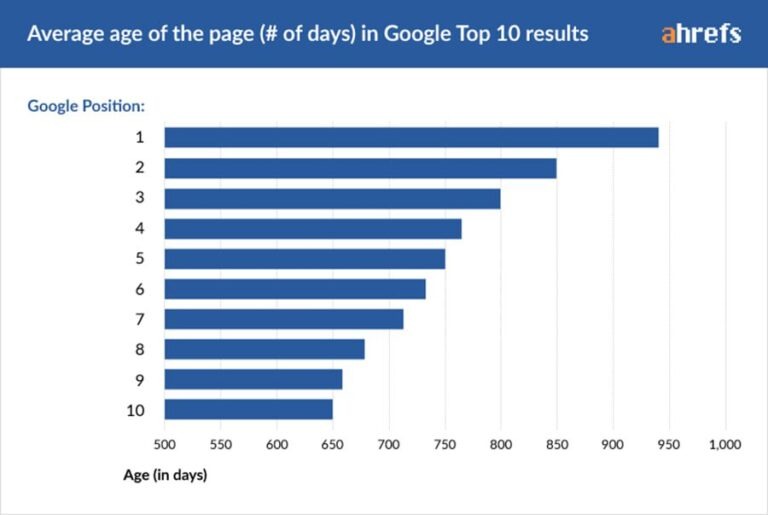
The second problem is that the range is older than it looks. In a study published on 15 May 2025, Ahrefs tracked a million pages published in 2023 for a year and measured 1.3 million United States keywords. Patrick Stox wrote it up. Only 1.74 percent of those pages reached the top ten for anything. In 2017, that figure was 5.7 percent. The same study looked at who sits at number one. The average number-one page is now five years old, up from two years.

Bar chart of average page age in Google's top ten, oldest at position one and falling with each place down.

This is Ahrefs' chart of average page age in the top ten, from an earlier run. The 15 May 2025 update puts the number-one page at five years old.

Read those two lines together. Getting onto page one got about three times harder. The advice didn't change. One of the pages still on page one for this question was written in 2015. That is not a scandal either. This happens when an answer is copied instead of being checked again.

Why can one number not be right?

Because your website does not run on one clock.

Think of a website as a row of separate machines sitting side by side. Your email setup is one machine. The code that counts your leads is another. The pages that show up in Google are a third. The sales you want from it all are a fourth. Each one runs on its own timer.

When you ask how long, you hold up the whole row and point at one dial. Whatever number comes back will be wrong for most of what you are holding. That is where "three to six months" comes from. It is the average of things that should never have been averaged.

One machine with four bays, each bay with its own gauge, and one wrong dial bolted across all four.

Here is what each dial really read, on work we have done, with the dates.

The real timeline, job by job

Table: What you bought
What you boughtHow longWhat proved it
An email to a list the business already hadWithin an hourA client sent one email to her own customers on a Saturday. She wrote to me that evening: "within an hour already 3 big orders." Her website was still being rebuilt.
Email settings fixed so mail lands in the inboxHoursA free public checker went from an F (55 out of 100) to an A plus (105 out of 100). The rule for fake mail went from "let it through" to "block it". The slow part came first: we read 223 delivery reports to make sure every real sender was already getting through.
Lead counting code that was counting the wrong thingOne dayWhen we found it, 9 of the 10 recorded leads were really phone taps being counted as form fills. We split the two that day and checked it on real visits the next day.
Hidden code still telling Google about services you droppedSame dayEight services had been taken off the page, but the code behind it still listed them. All six places in the code that still listed them were fixed and checked on the live site, not just the editor.
How often Google shows the whole siteWatched over twelve monthsA bathroom remodeler went from 120 showings a month to 6,690 between September 2025 and August 2026. That is about fifty-six times more. Clicks went from 14 a month to 39.
Visitors to an older site that was rebuilt, then grownYears, and still growingVisits up 890 percent, which is nearly ten times, from a small start.

The email settings, the lead-counting code, and the hidden code are fast for one reason. You already control all three. Nobody is competing with you to fix your own email or your own tracking. Showing up in Google and getting visitors are the opposite. Someone else already holds those spots. They got there first, and they are still working to keep them.

The email to the existing list is worth a closer look, because I nearly printed it as a website result. I went back to the original message thread before publishing. The site was still being built that week. The orders came from an email to people who had already bought from her, plus a few social posts. The fastest win I have ever seen for a client had nothing to do with the website at all.

The first honest thing anyone can tell you isn't how long. It is which row of that table you are in.

What does it look like when it does work?

This is a real account for a local barbershop. The numbers come from Google Search Console, not from memory.

In August 2025, its average spot on Google was 26.3. That is page three. By November, it was 12.0. The climb took about three months. Then came the part nobody shows you: it held. For ten months in a row it stayed between 10.5 and 13.2. Last month it was 10.6. That is not a spike, and it is not luck.

Now look at what happened to the visits over those same months.

Across those twelve months, the number of times Google showed the site fell by 55 percent. The clicks fell 22 percent, from 709 a month to 550. It climbed from page three to the edge of page one, but visits dropped.

That is not a failure. And I couldn't tell you that if I only printed the good line. The share of people who clicked went from 1.02 percent to 1.76 percent. That is up 73 percent. It went up because the searches that dropped away were never going to end in a haircut. But anyone who sells you a ranking as the goal should be able to explain those numbers. Most of them have never had to.

One more honest note about this account, because this article is about giving credit to the wrong thing. The site was redesigned, and I can date it. Tracking began in March 2016. The move to a new web address was planned that same week. They handed me the new site in May 2017. A year later, I told the owner that visitors had more than doubled. Every one of those dates is eight years older than the twelve months I just showed you.

So the redesign didn't move this site from page three to the edge of page one last year. It couldn't have. Search Console only keeps sixteen months of data. There isn't a clear before-and-after for a redesign that old, so I won't claim there is. What does show up inside those sixteen months is new search words. The week the climb started, the site began showing up for 154 new searches. Then 33 the next week, then 30, then just a few a week by this spring. That is a different story from a redesign, and it is the one the data supports.

Position is not the outcome

Read that account again, because it contains what no agency prints.

The ranking more than doubled, and visits went down. Both of those are true for the same twelve months, from the same tool, for the same business. If I showed you only the ranking line, it would look like a win. It would be true. And it still wouldn't be what the owner cares about.

What improved wasn't the number of visits. It was what each visit was worth. More people who saw the site clicked because the searches that dropped away never led to a haircut.

A good ranking is a first step, not the result. It opens the door. Whether anybody walks through is a second number. That number needs its own measurement tool and its own date. The answer to "how long before I see results" needs to specify which of the two you're promising. They do not show up together, and sometimes the second one never shows up.

A shop in the best position beside a separate counter that clicks only when somebody actually walks in.

Some searches are for people who are still learning, not buying. You can rank first for one of those, and your phone will stay quiet. That is not a timing problem. You selected the wrong search to pursue, and waiting won't fix that.

So what do people do while they wait?

They buy the leads. Almost everybody does. Almost nobody says so in an article like this one.

Go back to the plumbing company from the start. I measured it in July 2026. In ninety days, Google showed its pages 315,407 times, and those showings brought 310 clicks. That is one click for every thousand showings. Its average spot across the whole site was 27.4, which is page three. The searches that bring in money sat even lower.

Page three is not a ranking. It is a lot of people not seeing you.

So the phone does not ring on its own. The company takes the same steps that any healthy business does when free visits can't sustain it. It pays. It buys roughly 175 leads a month at about $200 each. They come from search ads, from lead websites, and from companies that charge per phone call. One of those call companies charges a flat $155 every time the phone actually rings. In one recent month, one lead website alone sent 53 leads for $7,935. That is just under $150 per lead.

The company's own tracking shows where the work comes from. It recorded 240 leads in thirty days. 149 came from ads on one search engine and 49 from ads on another. About four out of five leads are paid for. Google search on its own, with no ads, brings in about two leads a month.

The owner books about eighty percent of the leads that come in. Their own notes say it plainly: the problem is getting enough leads, not closing them. They are not bad at selling. They are hard to find, so they rent their spot on the page every month while the slow work runs.

A plumber books jobs through a rented feed with a toll on it while his own website stays buried.

Here's the part that should prevent anyone from reading this as the story of one struggling company.

Go back to the bathroom remodeler from the twelve-month row in the table. It ranks far better than the plumber. Its average spot is 16.6 over the last four hundred days and 11.9 over the last month. Its showings in Google went up fifty-six times in a year. It runs no search ads. I checked that instead of assuming it.

Its site had 2,493 visits in twelve months. Almost every one came from free search, social media, other websites linking in, or things the business owns. One exception: eight visits from the one service it pays for. That service is a lead website subscription at $455 a month. It is the only thing the remodeler pays for to get leads.

That subscription brings in about 11 or 12 leads a month. That works out to about $40 a lead. The plumber pays about $200. That is five times as much for the same thing.

And still, about four out of five of the remodeler's leads come from that lead website. Its own website form brings in the remaining fifth.

A bathroom remodeler's leads flow from a lead website straight to its office, bypassing its own busy website.

So here are two businesses. One ranks much better than the other and pays a fifth as much per lead. Both still buy about four-fifths of their work.

Neither company's ranking is feeding it. One of them has a much bigger bill.

Now look at what those eight visits mean.

The lead website sends the business's own website eight visits a year. The leads show up inside the lead website's own system. They never touch the business's site.

So the thing that brings in most of the work is not connected to the thing everybody asks me to speed up. They are not connected at all. I mean that plainly. You can move one a long way while the other sits perfectly still. That is exactly what a year of rising showings next to leads that did not rise with them looks like.

This is why "how long till my website sees results" needs a second question answered first: results at what? The site can get much better while the phone rings at the same rate. And nobody involved is lying.

The most expensive thing I have seen a business pay for

Go back to the plumber. There is one more layer under the $200.

Many of the people clicking those ads and being counted as leads were already customers. They had used the company before. When the drain backed up again, they searched, saw the ad at the top, and clicked it. And the company paid for another $200 lead.

This was not an accident, and I am not going to pretend it was a mystery. The ad account was set up to do it. Someone pulled the customer list out of the scheduling software. They loaded it into the ad platform so past customers would be shown ads for a full year. It had its own budget line. The written ad plan says ads shown to past customers work three to five times better than ads shown to strangers.

They do. Of course they do. These are people who have already paid you once.

So the ad platform reports a success rate several times higher than anything else. And that higher number is what gets used to justify the spending. The ad did not create the demand. The customer's last job did, and that job was already paid for. The account is charging a toll on a road the business already built.

A returning customer meets a toll booth bolted across the road to the company she already uses.

Now think back to the email sent to the existing list. The fastest result in this whole article was an email to people who had already bought, within an hour. It cost nothing. It is the same group of people, reached in two ways. One of those ways bills you every time somebody remembers your name.

Nobody means that when they say three to six months. And that is why the question has to be, "results at what?" Some of what a marketing budget buys is new customers. Some of it is a bill for customers you already had. Those are not the same purchase. They don't take the same time. And only one of them is worth waiting for.

The other choice was never "wait longer for the rankings." It was written into the same plan as the ad budget.

That plan included three other ideas. The first was a membership offer to make at the end of every finished job. The second was an email to the existing customer list. The third was a program to win back past customers, aiming for fifteen to twenty repeat jobs a month. All three reach the same people the ads were paying to reach. None of them charges a fee per click. None of them stops working when the card is declined.

The ad budget got funded. The other three stayed on paper.

Now compare that to the remodeler. The difference isn't talent, or luck. That business spends $455 a month. It owns everything else: the Google listing, its own web pages, its social media accounts, its email list. When its showings on Google grew fifty-six times in a year, it kept that growth. It did not rent it for a month.

Here's the honest answer to the timeline question, and it's difficult for my industry. Paid leads are fast, and they drop to zero the day you stop paying. Free leads you own are slow, and they keep adding up. Three to six months is about right for the slow kind. It is the wrong way to think about the fast kind. And many people who quote that number are selling you paid leads while describing the timeline for free ones.

There is a free option in between, and its problem is not what you would guess.

The remodeler's Google Business Profile, the free listing on Google Maps, costs nothing to run. It is already the business's third biggest source of visits. Only people typing in the web address and Google search itself send more. Turning viewers into customers is not its weak spot. But in ninety days, Google said the listing was found through just two searches, and one of them was the company's own name.

So the problem isn't the listing, and it isn't the ranking. The listing is fine. Google just isn't showing it to anybody.

Ranking and being found are not the same thing. A page can hold a top spot for a search nobody types. A listing can be built perfectly and still be shown twice. A report that only shows ranking makes both look the same. And neither one is fixed by waiting longer.

The same account has an even clearer example. I went into its data, hoping to find a win. I found the opposite.

Over ninety days, that site ranked between first and third for 74 different searches. Those searches showed the site to people 388 times. They brought one click.

Now compare a single blog post on the same site, from the same data pull. It sat down at ninth place. That one page was shown seven and a half thousand times and earned twenty four clicks.

Work out the rates, and they come out the same: about 3 clicks in 1,000, whether the page ranked ninth or first. Moving up eight places bought nothing anybody could measure.

Same site, same 90 days: ranking higher did not get more clicks

Ranked 1st to 3rd

74 different searches

388

times Google showed the site

1

click

About 3 clicks per 1,000 showings

Ranked 9th

One blog post

7,500

times Google showed it

24

clicks

About 3 clicks per 1,000 showings

Eight places higher. The same share of clicks.

From the site's own Google Search Console data.

Two warnings before you lean on this. First, it rests on a single click. One more visitor would change the rate a lot. Second, it is not a fair side-by-side. The ninth-place number comes from one blog post. The first-place number comes from seventy-four different searches, and people click on each one for different reasons. So treat this as a warning sign, not a rule.

But the direction is uncomfortable. It is the opposite of what a ranking report suggests when it shows you an arrow going up.

That list of searches has a second lesson, and it is the more useful one. The searches the site ranks first for include a misspelling of its own trade, the word "bleach", and the phrase "48 hours". Most of them were searched once or twice in three months. It ranks first for those because almost nobody is asking. That is not winning. It is an empty room with your name on the door.

This is not only true of one remodeler. In a study of over 80 million keywords and billions of search results, Sistrix measured how often people actually click each position on page one. Johannes Beus published it on 14 July 2020, and last updated it on 7 July 2025. The first result gets 28.5 percent of the clicks. The second gets 15.7 percent, the third 11 percent, and the tenth gets 2.5 percent.

Out of every 100 searchers, how many click each spot?

Each bar is 100 people. The dark part is the ones who click.

1st place28.5 click, 71.5 skip it

2nd place15.7 click

3rd place11 click

10th place, still page one2.5 click

Page one is not one place. Most people skip even the top spot.

Source: Sistrix, 80 million keywords, last updated 7 July 2025.

Flip that around. Even the spot everyone fights for is skipped by seven out of ten searchers. By third place, nine out of ten skip it. Page one is not one place. A ranking gets you a share of attention, and that share is usually smaller than the bill for it suggests.

A crowd fights to climb a tower of web pages while the real sale happens in a shop beside it.

And that share is still shrinking. In a study published on 4 February 2026, Ahrefs compared 300,000 keywords, half with an AI Overview on the page and half without. Ryan Law wrote it up. An AI Overview is the summary Google now writes at the top of some search results. When one was there, the top page got 58 percent fewer clicks than it would without one. A year earlier, that gap was 34.5 percent. The ranking did not change and the page did not change, but the gap grew. No timeline mentions this because a timeline is written once, and this changed after it was written.

Not everyone agrees on that number, and the disagreement tells you more than either figure alone. In a study of 5.47 million queries across 53 brands, covering 2.43 billion impressions from January 2025 to February 2026, Seer Interactive found that clicks were starting to come back on searches with an AI Overview. Tracy McDonald, Hannah Cooley and Marketa Williams published it on 24 April 2026.

By early 2026, 2.4 out of every 100 people clicked on those searches. On searches with no AI Overview, the number rose faster, from 2.8 to 3.8 out of 100. So the gap did not close. Whichever study you trust, a page that used to be the answer is now one of several choices on the screen.

Seer also found the one thing anyone has shown helps here, and it is not ranking. Pages named in the AI Overview got 120 percent more clicks per showing than pages that were not named. Being on the page is not what matters. Being named in the summary is.

What Google's AI summary does to the top result

Fewer clicks for the top page when a summary is shown

Spring 202534.5% fewer

Early 202658% fewer

Same ranking, same page. The gap grew. Source: Ahrefs, 300,000 keywords.

Out of every 100 showings, how many clicked (early 2026)

No AI summary3.8 clicks

With an AI summary2.4 clicks

The bars are stretched so the gap is easy to see. Source: Seer Interactive, 5.47 million searches.

The one thing that helped: pages NAMED inside the summary got 120% more clicks than pages that were not.

So there are three steps, not one. Ranked, then clicked, then a lead. Most of the industry sells the first step and hints that the other two come with it. A ranking is not the goal. From what we have seen here, it is not always even halfway there.

The best position in an empty arcade, beside a worse position on a street full of people.

That is what the three-to-six-month answer leaves out. It does not lie about search. It just says nothing about the bill you pay the whole time you wait, or about whether that bill ever stops.

What should you ask instead?

Here are four questions. If you know what you're selling, you can answer them on the first call.

  • Which part of the work is this, and how long does that part take? If one number covers everything you bought, it averages things that do not belong together.
  • What is the first number you will show me, and on what date? Not a report. One number, from a named tool, on a date you can put in your calendar.
  • What result would tell us this is not working? Agree on that number before anybody starts. A plan that cannot fail is why vague timelines last so long.
  • Once the ranking comes, what should happen next, and how will we see it? People ask this last. It should be asked first. Agree on the second number before the first one starts to move.

A vague timeline is not a gentle answer. It is a useful one for the person giving it. Three to six months is two quarters of bills where nothing can be judged. And in the end, nobody can say it missed, because the number was never clear enough to miss.

I would rather be held to something. So here is mine. The technical fixes take hours or days, and you will see the numbers change while we are on the call. Showing up more often in Google takes months, and the first honest check is at ninety days. Beating strong competitors for a popular search takes years. I will tell you before we start whether the search you want is one of those.

Which clock were you quoted? Twenty seconds

Answer out loud.

The last time somebody gave you a timeline, did they say which part of the work it was for?

If it covered all of it, that was not a real estimate. It was a number no one could check. By the time anyone could check, everyone would have moved on.

Below are three questions that tell a real estimate from a guess. Tick each one you can answer about the last timeline you were given. The box at the bottom tells you what your answers mean. It changes with each box you tick, because each missing answer causes a different problem.

Check your timeline: three questions

Think about the last timeline someone gave you. Tick each question you can answer. The box at the bottom tells you what your answers mean.

A website is not one job. Some parts take a day, like fixing your email settings or the code that counts your leads. Other parts take years, like beating your competitors in Google. One timeline for all of it is an average of an hour and a few years, so it is wrong for both.

Some fixes get finished. You can see they are done and stop paying for them. Other work, like showing up more in Google, is never done. It just keeps growing. So if someone gives you an end date for that kind of work, ask what exactly will be done on that date.

Not a report, and not a check-in call. A real date, and one number you will look at together that day. A guess with no date can never be proven wrong. That is what makes it so easy to give.

This is a real estimate. You know what the work is, whether it ends, and when you will see proof. Put that date in your calendar and ask for the number on it.

You have no date, so nobody can ever be wrong. Ask what number they will show you, and on what day. Until you have that, you have a promise, not a plan.

Nobody said if this work ever gets done. If it is a fix, ask what will show it is finished. If it is the kind of work that keeps going, there is no end date to wait for.

One timeline is covering more than one kind of work. An hour of work and a year of work are being averaged into one number, and the average is wrong for both. Ask which part of the work it is for.

You know what the work is, but you have no way to check it. With no end point, nobody has to say when it is done. With no date, nobody has to show you anything.

You were told the work will end, but not what the work is. So there is nothing to check the end against.

You have a date, but nothing to check on it. You do not know what the work is or if it ends, so that meeting has no number that can settle anything.

This is not an estimate. It is a number with nothing behind it: no named work, no end point, no date. It can never turn out to be wrong, and that is why it was safe to say.

Questions people ask about marketing timelines

How long does SEO really take? For a search nobody else is going after, it can take a few weeks to a few months. For a search your competitors are working hard on, plan for years. The usual answer of four months to a year is the middle of that range. It hides both ends.

Why do agencies all say three to six months? Because it is about right for the middle case. It is also long enough that you can't judge anything before two quarters of bills are paid. Most people who quote it are repeating what they were told, not what they measured.

What should I see in the first month? Fixes you can check for yourself, and a starting number to measure from. If month one brings a report and nothing you can check on your own, ask what was measured and how.

Is it worth doing if it takes that long? The fast jobs are worth doing no matter what. Several of them take an afternoon and keep paying off. The slow jobs are worth it when the search is one your buyers really use before they buy. Those are two different choices, so make them one at a time.

Does a ranking guarantee more customers? No. One of the businesses in this article more than doubled the quality of its ranking over twelve months. Its visits fell 22 percent in the same year. A ranking is a first step. Customers are a different number, and they need their own measurement.

What if it has been six months and nothing has happened? Then nobody agreed up front on what would count as working. That is the real problem. Ask what the first number was, what it read at the start, and what it reads now. If nobody can show you those three numbers, time was not the problem.

The next article in this series is for anyone who is not sure which job their timeline was for. It covers what happens when someone gives up too early: We tried it for a month and it did not work (coming soon). If you are not sure your numbers can be trusted, start with running ads with broken conversion tracking. A timeline is only as good as the tool that measures it. And if you would like someone to look at your own account and tell you which jobs are fast and which are slow, request a free site analysis.

MARKETING TIMELINES, JOB BY JOB

How long till my website sees results

Google's page one answers it with one number. But that number covers six different jobs. Four of them get done. Two of them never do.

One workbench holding two instruments: a short arm parked against a solid end stop, and a long rail that runs off the bench and keeps going.

WHAT THE INDUSTRY PUBLISHES

The answer page one gives, word for word.

Seven publishers hold page one with a readable answer. This is what they say, word for word, pulled 19 September 2026.

Low competition keywords

the fastest figure anybody publishes

2 to 3 months

The consensus answer

quoted by most of page one

4 months to a year

Significant success

the same range under a different name

4 to 12 months

Small improvements first

then 6 to 12 for stable positions

3 to 4 months

None of the seven gives a timeline for each job. None says what happens after you rank. None shows dated numbers from a real client. They all answer one question: how long until the ranking moves.

Nine notice boards in a row, every pointer resting at the same place, and one board weathered and grown over with ivy.

WHAT A POSITION IS ACTUALLY WORTH

Click share by position, and who measured it.

What a position is worth, measured. Page one is not one place, and the difference between the top of it and the bottom is more than ten to one.

Position 1

Sistrix, 80,000,000 keywords

28.5%

Position 2

Sistrix, 80,000,000 keywords

15.7%

Position 3

Sistrix, 80,000,000 keywords

11%

Position 10, still page one

Sistrix, 80,000,000 keywords

2.5%

And the share is still moving. Ahrefs measured a 58 percent lower rate where an AI Overview appears, across 300,000 keywords. Seer measured that rate recovering through early 2026, across 5.47 million queries, while the rate without an AI Overview rose faster. The two disagree on the size. Neither says a position is worth what it was.

A huge gateway wound almost shut, with worn polished paving underneath showing how wide the opening used to be, and a crowd waiting.

AND THE PART PAGE ONE LEAVES OUT

The odds got worse while the published answer stayed the same.

Ahrefs tracked a million newly published pages for a year, and 1.3 million United States keywords, and measured both twice.

Reached the top ten within a year

5.7% in 2017 → 1.74% in 2023

Age of the average number one page

2 years in 2017 → 5 years in 2023

None of the seven publishes a dataset of its own, and one of them has been ranking since 2015.

Ahrefs, “How Long Does It Take to Rank in Google”: 1,000,000 newly published URLs tracked for twelve months, and 1,300,000 United States keywords for page age. Fetched at source 19 September 2026.

Two identical walls of a hundred lamp sockets standing side by side, with six lamps lit on the near wall and only two lit on the far one.

WHAT ACTUALLY MOVES IT

Five moves that help, in the order they pay off

A workbench carrying five different pull levers in a row above five blank plates, the first already pulled down and the other four upright.
1

Fix what nobody is competing for, first

Your email settings, your lead tracking, the hidden code that describes your business to Google. Each takes a day or less, because nobody else is trying to fix your settings.

2

Check if people search for it before you chase a ranking

Run the five minute test. A first place that Google showed fewer than 10 times in 90 days is not a win you can spend.

3

Pick an easy search on purpose

Searches with little competition are the only ones on page one with a short timeline: 2 to 3 months. Everything else on that page says 4 to 12.

4

Publish sooner than feels comfortable

The average number one page is now five years old, up from two. You can never buy back the time a page has been live.

5

Measure clicks, not the ranking

If your ranking gets better but no more people click, you have not gained anything you can spend.

A business owner at her own reading instrument with both hands on its controls, an egg timer run through beside her and a blank notepad open.

DO THIS NOW

The five minute test, on your own account

Everything below is your data, not mine. It takes about five minutes and it produces the same number this article is built on.

1

Open Search Console, then Performance, then Search results.

Set the date range to the last 3 months. Switch on Average position and Total impressions. Impressions means how many times Google showed you.

2

Open the Queries tab and sort by Position, smallest first.

These are the searches you already win. This is the list an agency screenshots for you.

3

In the Impressions column, count how many of those top positions sit under 10.

Every one of those is a first place nobody is asking for.

4

Now sort the same table by Impressions, largest first, and look at the positions.

The pages that get seen are usually not the pages you rank first for.

5

Divide clicks by impressions for both groups.

Compare the two rates. If a better position is not buying you a better rate, more ranking work is not what you are short of.

If most of your first places have almost no impressions, more ranking work is not your next move. Demand is.

One walkway crossed by three separate structures: a crowd under the first, a fraction of them through the second, and a handful at the desk.

THREE EVENTS, NOT ONE

Ranked, then clicked, then a lead.

Most of the industry sells the first and implies the other two arrive with it. Each one is measured somewhere different.

RANKED

Check it here: Search Console, Performance, Average position

You hold a place in a list

CLICKED

Check it here: Same report, Total clicks against Total impressions

Somebody chose you out of that list

A LEAD

Check it here: Your own form, phone or inbox, counted separately

Somebody asked you to do the work

TAKE THIS TO THE NEXT CALL

What to ask when a timeline is quoted at you.

If you are promisedAsk forBecause
We will improve your rankingsWhich searches, and how many people make them each monthA top spot that nobody searches for changes nothing
Three to six monthsWhich part of the work that timeline is forSome fixes take a day. Showing up in Google never ends
The leads will followHow many people click on us now, at the spot we hold nowRanked, clicked and a lead are three different steps
Your listing needs optimizingHow many searches the listing was shown for last monthA perfect listing that Google shows twice is not being seen, not badly built

WHAT TO SAY

Ask for it in one sentence

“Before we talk about how long, which part of the work is that timeline for, and what number will you show me on what date?”

Ask it on the first call. It is not a challenge and it does not start a fight. Anyone who measures their own work will have the answer ready.

I would rather tell somebody their best positions have no demand behind them and lose the sale, than take a retainer to move a number that was never going to pay them.

ROBERT DOVE · DOVE WEB CONSULTING

Customers walking into a busy business along a stone walkway with no gate, no meter and no toll on it, the rocket lit behind.

Ranked, clicked and a lead are three different events, and only one of them pays the invoice.

Run the test before you agree to a timeline

Five minutes in your own Search Console will tell you whether the positions you already hold are being searched for at all.

Request a free site analysis

Sources. Ahrefs, How Long Does It Take to Rank in Google, Patrick Stox, 15 May 2025 · Sistrix, Why (almost) everything you knew about Google CTR is no longer valid, Johannes Beus, 14 July 2020 · Ahrefs, Update: AI Overviews Reduce Clicks by 58%, Ryan Law, 4 February 2026 · Seer Interactive, AIO Impact on Google CTR, 2026 Update, Tracy McDonald, Hannah Cooley and Marketa Williams, 24 April 2026.

Dove Web Consulting, Spring Hill, Kansas.

dovewebconsulting.com