Spring Hill KS, 66083

- Home
- > Blog Main Page
- > Leads & Funnels
- > The landing page you rent, and the page you own
The landing page you rent, and the page you own
09.03.2026
DoveWebConsulting
You paused the campaign in January.
Cash is always tight after the holidays. It was going to be for a few weeks, and the landing page had converted all autumn, better than anything else you owned. It could sit there.
Then nothing came in. Not fewer leads. Nothing.
You checked that the page was still live, because that is the first thing anyone checks. It was live. It looked exactly the same as it had in October.
It had simply never had a way for a human being to arrive at it, except through an ad you were no longer paying for. And nobody had ever told you that, because the person who built it had no reason to.
The landing page did exactly what landing pages do. The problem is that nobody told you which one you were buying.
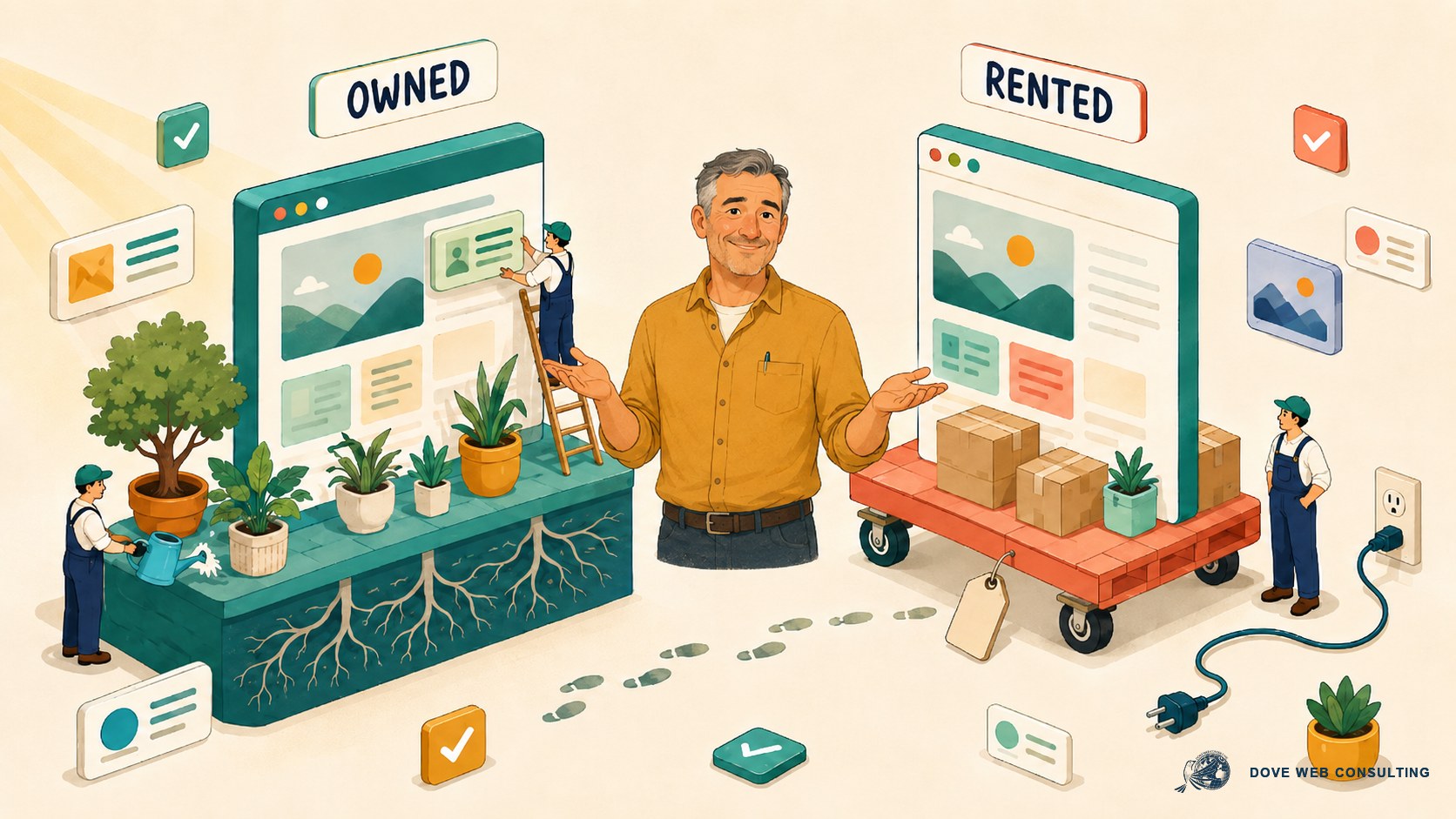
Rent and own are two different products
Every dollar you put into a rented page buys you a visit.
Every dollar you put into a page you own buys you a visit and an asset, something that keeps producing after the campaign budget is gone.
Both are legitimate purchases. They are just not the same purchase, and most people make the second decision by accident while thinking they made the first. Renting a page is like renting a shop unit on a busy street. The fittings are yours and the trade is real, but the footfall belongs to the landlord.
What "rented" actually means, in the vendor's own words
This is not an opinion about landing page builders. It is documented by the builder itself.

Unbounce's own documentation says it outright: "Search engines will not index (i.e., include) pages hosted on unbouncepages.com, so connecting your domain enables your page to show up on that Google search results page." If your page lives on the builder's default domain, it is invisible to organic search by design. The same page notes those URLs are not SSL-enabled either, which is its own conversation. An SSL certificate is the padlock in the address bar, and it works like a passport: it has an expiry date somebody set once.
Connect your own domain and you still have a decision to make, and their documentation is equally direct about that one: "If your goal is to improve SEO rankings, and to drive organic traffic to your landing page, it would be better to use a subfolder when setting up your landing pages. Subfolders are part of the main site and share domain authority."
Read that last sentence for what it does not say. Subfolders share the authority. A subdomain like offer.yourcompany-dot-com sits outside that. Think of it as the difference between a room and a shed. A subfolder is a room inside your house: it shares the address, the post arrives there, and anything good about the house is true of it. A subdomain is a shed at the bottom of the garden with its own address on it.
So offer.yourcompany-dot-com and yourcompany-dot-com/offer are not cosmetic variants. The first does not inherit what the second has spent years earning. Every link it earns, every bit of trust it accumulates, banks into a property that isn't the one you're trying to grow.
The part that costs you twice
There is a second bill on a rented page, and it lands in your reporting rather than your rankings.
When a visitor moves between two different domains, tracking does not follow them by default. The session breaks. It is like handing a parcel to a second courier at the county line: the paperwork stops at the handover, and whoever carries it the rest of the way has no idea where it started. The original source is lost. What was a Google Ads click becomes, on the other side of the hop, a direct visit or a referral from your own domain.
Which means the page you built specifically to prove your advertising works is the page most likely to be unable to prove it. You end up with a conversion you can't attribute, in a channel report you can't trust, making a budget decision you can't defend. It is fixable, because cross-domain tracking is a configuration and not a law, but it is off by default, and default is what most setups ship with.
SEO page or PPC page. You are choosing, whether or not anyone asked you
The industry does have a name for this. Every guide on landing pages eventually splits them into two types: the SEO landing page, built to earn organic traffic over time, and the PPC landing page, built to convert a visitor who has already arrived from an ad.
What almost none of them do is tell you the consequence of the split, which is this: the two types are not two styles of writing. They are two different assets with two different lifespans. One appreciates and one expires. The choice of which you are building is made by where you host it and how it is linked, and it usually gets made by whoever set up the account, on a Tuesday, without anyone framing it as a decision at all.
A page that targets no search will not rank, wherever you put it
Here is the part that complicates my own argument, and it should.
Moving a rented page onto your own domain does not automatically make it rank. Most landing pages are written to convert someone who is already there. Nobody asked what question the page answers, because the ad was doing the finding. So the page is built around an offer instead of around a query, and dropping that same page into a subfolder gives it authority it still cannot use.
If you want a page to earn traffic, someone has to decide, before it is written, which search it is the best answer to. That is not a formatting job or a plugin. It is twenty minutes of deciding what the page is for, and it is the step that gets skipped in almost every build I have audited.
The honest sequence: decide the query, write the page around it, host it where the authority accrues. Doing only the third one gets you a well-located page nobody searches for.
Where the links land
This is the mechanism underneath everything above, and it is worth being concrete about.

Suppose the page is good. A supplier links to it. A local paper mentions it. Someone puts it in a roundup. Each of those links is a vote, and votes are the currency that makes the rest of your site rank too.
If the page lives on the builder's domain, those votes go to the builder. If it lives on your subdomain, they go to a property that is not the one you are trying to grow. Only if it sits in a subfolder of your main site do they compound into the thing you actually own.
And there is a tail on this. When you eventually decide to move the page, and if the offer is permanent you will, you either set up a redirect and recover some of that equity, or you don't and you lose all of it. The move is cheap the week the page is built and expensive three years later.
Rent or Own
A landing page on someone else's domain converts while you pay for traffic, and is worth nothing the day you stop. This tells you which one you built.
So when should you rent?
Renting is the right answer more often than a purist will admit.
Rent when:
- The offer is temporary. A seasonal promotion, an event registration, a single campaign that ends.
- The traffic is paid and will stay paid. You are not asking this page to rank; you are asking it to convert.
- You need it live this week and your site has a development queue measured in months.
- You want to run five variants against each other by Friday. Builders are genuinely excellent at this, and a CMS usually is not.
Own when:
- The offer is permanent. Your core service, your main lead magnet, the thing you will still sell in two years.
- You want it to still produce something after the ads stop.
- The page is the natural destination for a search someone is already performing.
- You are building a body of proof, things like case studies, comparisons and calculators, that should compound rather than reset each campaign.
The test
Ask one question about any page you are about to build:
If I turn the ads off for ninety days, what is this page worth?
If the honest answer is "nothing, and that's fine, it's a campaign page," rent it, on the builder's platform, and don't feel bad about it. You bought exactly what you needed.
If the honest answer is "it should still be working," then it needs to live on your domain, in a subfolder, internally linked from pages that already have authority, and indexed. Anything else is paying for an asset and receiving a rental.
The expensive mistake isn't renting. It's renting while believing you bought.
Now walk it
You have the argument. Here is the map.
Five questions, and every ending hands you a sentence you can say out loud to whoever asks why. That last part matters more than it sounds. A decision you cannot explain is one you will quietly reverse the first time somebody pushes back on it.
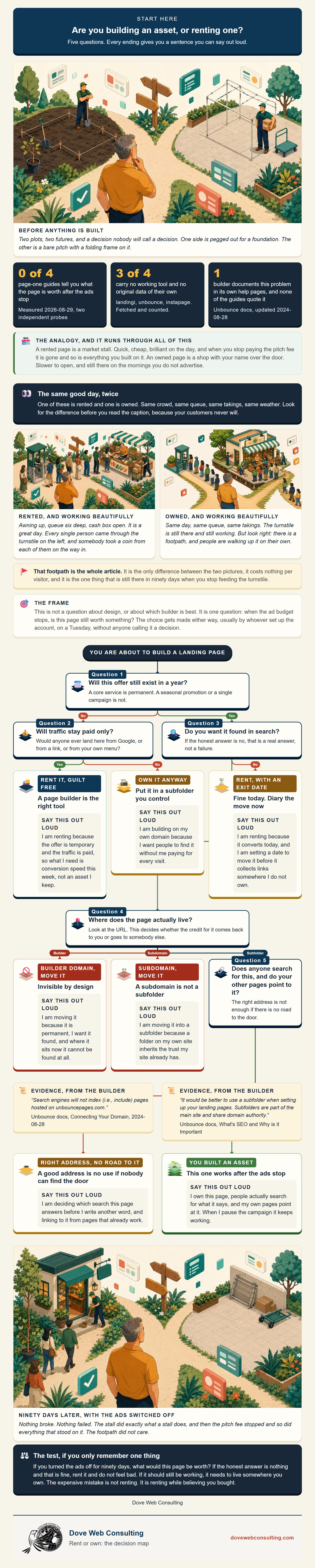
The map has a text version that provides key information. Of four page-one guides, none indicate the page's value after the ads cease (as measured on August 29, 2026, by two independent sources). Three of the four guides include no useful tools or original data. One builder highlights this issue in its own help documentation, but none of the guides reference it.
Question 1. Will this offer still exist in a year? A core service is permanent. A seasonal promotion or a single campaign is not. Yes: go to Question 3. No: go to Question 2.
Question 2. Will traffic stay paid only? Would anyone ever land here from Google, or from a link, or from your own menu? Yes: Rent it, guilt-free. No: Own it anyway.
Rent it, guilt-free. A page builder is the right tool. Say this out loud: I am renting because the offer is temporary and the traffic is paid, so what I need is conversion speed this week, not an asset I keep.
Own it anyway. Put it in a subfolder you control. Say this out loud: I am building on my own domain because I want people to find it without me paying for every visit.
Question 3. Do you want it found in search? If the honest answer is no, that is a real answer, not a failure. Yes: go to Question 4. No: Rent, with an exit date.
Rent, with an exit date. Fine today. Diary the move now. Say this out loud: I am renting because it converts today, and I am setting a date to move it before it collects links somewhere I do not own.
Question 4. Where does the page actually live? Look at the URL. This determines whether the credit comes back to you or goes to somebody else. Builder domain: move it. Subdomain: move it. Subfolder: go to Question 5.
Builder domain: move it. Invisible by design. Say this out loud: I am moving it because it is permanent, I want it found, and where it sits now, it cannot be found at all.
Subdomain, move it. It does not get your site's trust the way a subfolder does. Say this out loud: I am moving it into a subfolder because a folder on my own site inherits the trust my site already has.
Question 5. Does anyone search for this, and do your other pages point to it? The right address is not enough if there is no road to the door. No: Right address, no road to it. Yes: You built an asset.
Right address, no road to it. A good address is no use if nobody can find the door. Say this out loud: I decide which search this page answers before I write another word, and I link to it from pages that already work.
You built an asset. This one works after the ads stop. Say this out loud: I own this page, people actually search for what it says, and my own pages point at it. When I pause the campaign, it keeps working.
Use this infographic
You are welcome to republish this graphic anywhere, including commercially, as long as you credit Dove Web Consulting and link back to this article. No permission request needed.
Paste this to embed it with the credit already attached:
<a href="https://dovewebconsulting.com/blog/landing-page-rent-or-own/">
  <img src="https://dovewebconsulting.com/mt-content/uploads/2026/09/rent-or-own-infographic-dove-web-consulting-20260903_6a99f75b20926.jpg"
       alt="Decision map infographic: five questions and seven endings for whether to rent or own a landing page." width="100%">
</a>
<p>Infographic by <a href="https://dovewebconsulting.com/">Dove Web Consulting</a></p>
If you cannot paste HTML, this line is enough: Infographic by Dove Web Consulting, dovewebconsulting.com
This is the second decision. The first one is whether your measurement is honest enough to spend against at all. Running ads with broken tracking doesn't waste your budget →