Spring Hill KS, 66083

- Home
- > Blog Main Page
- > Websites
- > What a technical marketing person actually does all day
What a technical marketing person actually does all day
09.22.2026
DoveWebConsulting

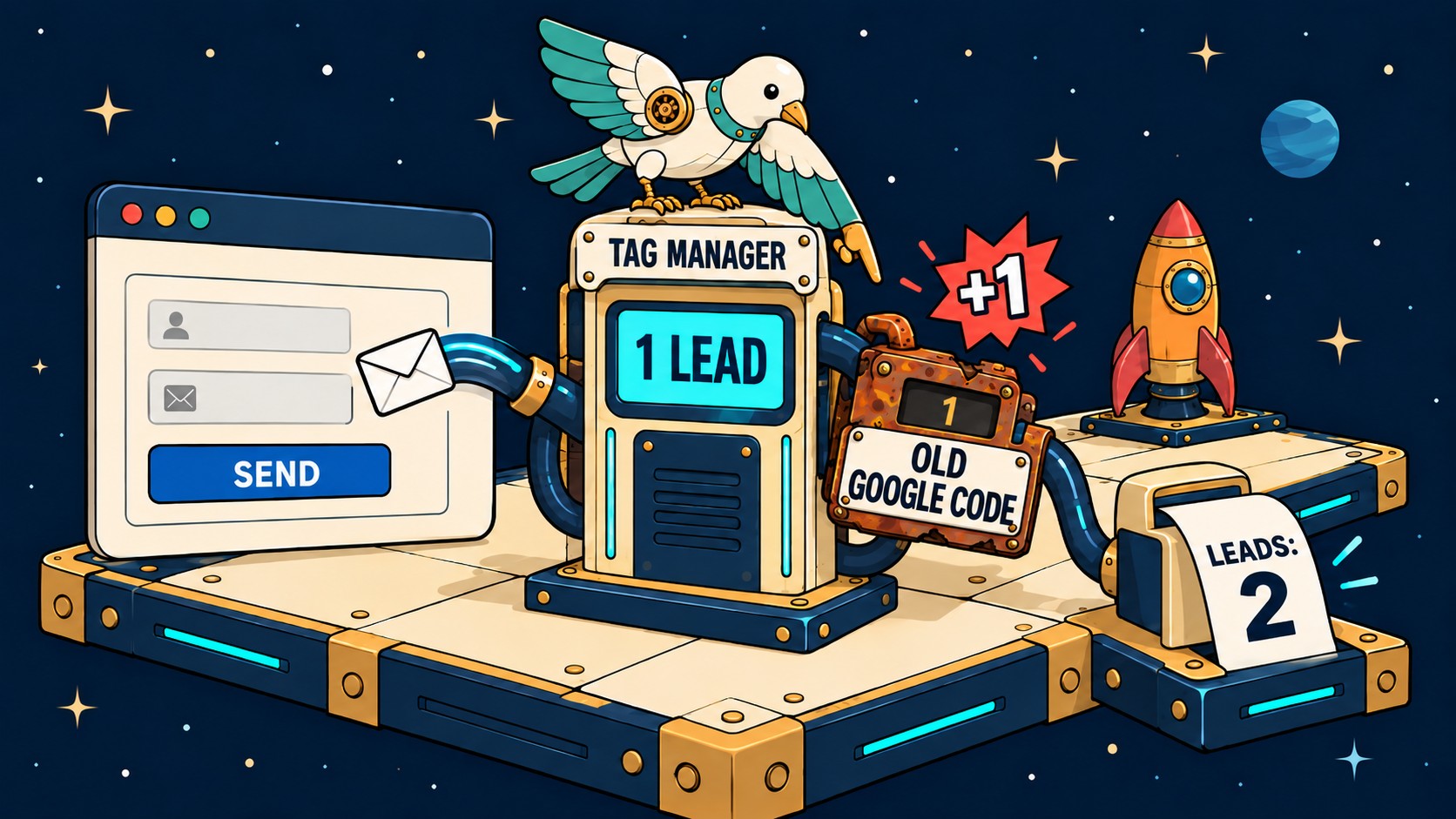
Somebody asks for one thing. Put this tracking snippet on the site so we can see which ads produce phone calls.
Marketing does not have the login, and the last time one went in by hand the contact form stopped sending for a day. IT has the login, and will do it in the next release window, once somebody tells them exactly where it goes and what it is meant to count. Nobody in that thread is being difficult and nobody in it is wrong. The request is small, and it sits for three weeks.
It sits because it is not a marketing task and it is not an IT task. It is the translation between the two, and translating is a job even when nobody has been handed it. Eventually somebody pastes the snippet in to be helpful. It starts counting the wrong thing, and the gap stops looking like a gap, because now there is a number.
The cost is not a missing campaign
A missing campaign is easy. You notice, and you run it. What this costs you is worse and quieter: a real campaign whose number is wrong, and a quarter of decisions made on top of it.
I have done this to a client myself. I reported a conversion rate about four times higher than the truth, because a tag was counting something that was not a lead. Nothing errored. No alert fired. The team planned a quarter against a number that had never been real, and my first useful deliverable was making the headline number worse.
The picture everyone has of this job is wrong
There is a famous infographic that has shaped how businesses picture this role for more than a decade. One person, split down the middle. On the left a beanie and a pencil: writing, visuals, social, email. On the right a lab coat: tracking, operations, analytics, campaign performance. Part artist, part scientist.
It is a good drawing, and it has cost people a lot of money.
If you believe the job is a blend of two jobs, you go looking for one person who can do both. In practice you hire a capable marketer who can also pick up the technical side, because that is the half you know how to interview for. And the technical half is the half that fails quietly. A badly written campaign is obvious in a week. A tag counting the wrong thing is obvious in a quarter, if anyone catches it at all.
The job is not half of each. It is a third thing that sits between them, and the closest job to it is not a marketing job at all. It is an interpreter.
Why nobody will tell you that you do not need one
Before writing this I went and read who actually answers this question online. The answer turned out to be more useful than any of the articles.
Search for what a technical marketing specialist does and you land in a hiring aisle. Eight of the nine results are job boards, job description templates and interview guides. Every one is written for somebody deciding whether to take the job. Not one is written for somebody deciding whether the job should exist.
Change the question to whether you should hire one, and the audience flips. Now all ten results are written for the owner. But eight of those ten are published by somebody who makes money when you hire: agencies, a hiring marketplace, a consultancy, and a company that sells the software the role would run. Two are neutral, a magazine and a book publisher.
That is not a scandal and it is not an accusation. It is arithmetic. A page that opens with you probably do not need us is a page that costs its author the sale, so it does not get written. Which means the two things you most need to know, what this person actually does and when you can skip them entirely, are the two things page one is structurally unable to tell you.
Here is how strong that is. Search the title of this article and read what the summary says the day looks like. It gives you a morning of writing: how-to guides, labs, white papers, demo scripts for the sales team, answering questions in developer forums. Then, fifth of six bullets, in the afternoon, one line: reviewing analytics, checking tracking tags, configuring the data pipelines.
Those are two jobs. The first five are the writer. The sixth is the person this article is about. They are printed as one day, under one title, and nothing in the summary marks the seam.
That is the whole problem in one search result. And notice which of the two gets one line out of six.
Why this job exists at all
It is worth asking where a job like this came from, and the honest answer is that nobody can point at a founding date. What can be counted is the thing that created the need.
How many systems there are to disagree with each other
Marketing software products a business can buy, counted each year, 2011 to 2026. Not people and not job titles — tools. Each bar is one year's total.
2011
150
2016
3,500 approx
2017
6,829
2023
11,038
2024
14,106
2025
15,384
2026
15,505
Read it as a count of things that can disagree. Every bar is one year's total, and every product in it is something somebody can buy without telling anybody — another place a number can come from.
Source: the annual Marketing Technology Landscape compiled by Scott Brinker with Frans Riemersma, published at chiefmartec.com. The 2011 baseline, the 2024 figure and the whole 2026 row including the added and removed counts were read at the source rather than taken from a search summary; 2016 is reported as approximate because that is how it is reported. The 2026 figure is the one its own authors describe as a plateau.
A hundred and three times as many products in fifteen years, and then a flat line at the end. That flat line is the part worth reading twice. The total moved by only a hundred and twenty one products between 2025 and 2026, which looks like the problem settling down. Underneath it, 1,488 products were added and 1,367 were removed. Nothing settled. Close to one in five of everything on the shelf was rearranged while the number on the front of it held still.
Every removal there is a system somebody had to move off, and every addition is a system somebody had to wire in. Both of those are the job this article is about, and neither shows up in the total.
It is the same trick as the number on the tag. A gap stops looking like a gap once there is a number over it, and a year of churn stops looking like churn once the total comes out flat.
The market noticed the work, if not the name for it, and the naming has never stopped moving. In 2020 Scott Brinker sorted the people doing it into five kinds: the brand and demand builder, the operations orchestrator, the analytics architect, the marketing maker, and the manager over all of them. By his State of Martech 2026, published in May, the operations half had been renamed twice more, from system administrator to stack wrangler to context engineer. Revenue operations broke off as its own function with its own salary bands somewhere in the middle of that.
Here is what nobody publishes: a count. The one job tracker that could break these postings out by title reports them by seniority instead, 191 open marketing operations roles in the last week of July, sorted director, senior, mid and entry, with not one title named. So the honest version is not that the job split into more specializations. Nobody can show you that it did.
You can watch that happen. Put the three names into Google Trends together, United States, all the way back to 2004, and marketing technologist never leaves the floor. Not once in twenty-two years. Marketing operations and revenue operations both sit flat beside it until around 2021 and then climb steeply, and the one at the top of the chart is the youngest of the three. The names that won are the recent ones, and the older ones did not survive to share the space with them.
What is visible is the same shape as the chart above. The shelf holds still while its contents churn. The job holds still while its name churns. Marketing technologist, marketing operations, revenue operations, go-to-market engineer, context engineer, four replacements in fifteen years for work that has not changed much. Which is exactly why the title is such a poor description of the job, and why the wrong person keeps getting hired for it.
So here is both.
What the job actually is

Picture a deal being done through an interpreter. Two parties, both completely fluent, neither able to hear the other. Marketing says the campaign produced forty leads. IT says the endpoint fired forty times. Both sentences are true, and they are not the same sentence.
An interpreter is not half of each language. They have their own training and their own job, and their value comes from the one thing neither party can do: hold both sides to a single sentence that means the same thing in both rooms.
That is the deliverable. Not a campaign and not a report. A sentence, written down, that two departments have agreed to be measured by. Something as plain as: a lead is a form submission that reached the CRM with a phone number attached, and when the ad platform disagrees with the CRM, the CRM is right.
Written out like that it looks too small to be a job. Nearly every measurement argument I have ever sat in was an argument that one sentence would have ended before it started.
What it looks like on an ordinary Tuesday
Two real ones. Neither is glamorous, and that is the point.
One. On a home services client, two search phrases: sewer camera inspection, and how often should you get a sewer camera inspection. The first is somebody buying. The second is somebody maintaining what they already own. One phrase is a substring of the other and they are about seventy five percent identical word for word, so every automatic matcher I tried merged them into one bucket. Substring matching merged them. Word overlap scoring merged them. Merged, the report says the page is winning, while the page is quietly losing the half of the traffic with money attached. The fix was a rule, not a tool: match exact phrases only, and where the data has no record, say so instead of inferring. That rule cost two failed attempts to learn.
Two. A client removed a marketing platform. The plugin was deleted, the code was clean, and the live page still carried eight traces of it. Two separate caching layers were still handing out the old version to real visitors. Purge one, purge the other, re-read the plain address: eight became zero. Comparing the live page against the origin server is what proved it was cache and not code, and that is the difference between an afternoon and a week.

Neither of those is visible from the marketing chair. Neither is visible from the IT chair. Both were somebody's actual Tuesday.
If what you want is the narrower version of this, where exactly an inquiry dies between two systems, that is its own piece: the lead handoff nobody owns.
What it is not
Five things this job gets confused with. Each confusion costs a hire, and the first one costs the most, because the market uses one name for both.

Not a technical content writer. That is the job page one describes: whitepapers, spec sheets, demo videos. A real job, and a different one. The same title is used for both, which is why so many postings and so many hires do not match. She is producing the words about the product. Nobody in that room is producing the connection between two systems.

Not an analyst. An analyst reads the number. This role decides which number counts, before anybody reads it. The card that would say what the chart is counting is sitting blank in the foreground, closer to you than the chart itself.

Not a developer. A developer builds what the specification says, and builds it well. This role writes the specification and then checks the built thing behaves the way it claims. Two things are missing from that bench and they are the two halves of the job: the sheet nobody wrote, and the glass nobody picked up.

Not a marketing strategist. They choose the campaign, and choosing well is hard. This role makes the campaign's result checkable by two departments who report to different people. The scale on the line between those two halves of the room is empty, and it is empty in most companies.

And not a blend of artist and scientist. The idea that it is half of each is what makes you hire the wrong person. It is a third thing, which is where this article started.
When you do not need one
The part nobody selling this will print.
You do not need one if you run one channel, one site and one CRM, and the person who set it all up still works there. Nothing above applies to you yet. Write down who owns what while it is still simple, and get on with your week.
Somebody has to hold it when two systems have to agree with each other and nobody owns the sentence that says what agreement means. That is the entire test, and it does not care how big you are.
| You do not need one | You need one |
|---|---|
| You run one channel. | Two systems have to agree with each other. |
| One site, one CRM. | Nobody owns the sentence that says what agreement means. |
| The person who set it up still works here. | The person who set it up has left, or is about to. |
Five questions, ten minutes
You do not need a diagnosis to find out which side of that you are on. You need five answers. Give the honest one, not the one you intend to be true next quarter.
Do you need one? Five questions, ten minutes.
Answer about your business as it is today, not as you intend it to be.
1.Who can publish a tracking tag on your site right now?
2.What counts as a conversion in your reports?
3.Where does a form submission actually go?
4.When two tools disagree, which one is right?
5.Who finds out when an integration stops working?
0 of 5 answered
What these words actually mean
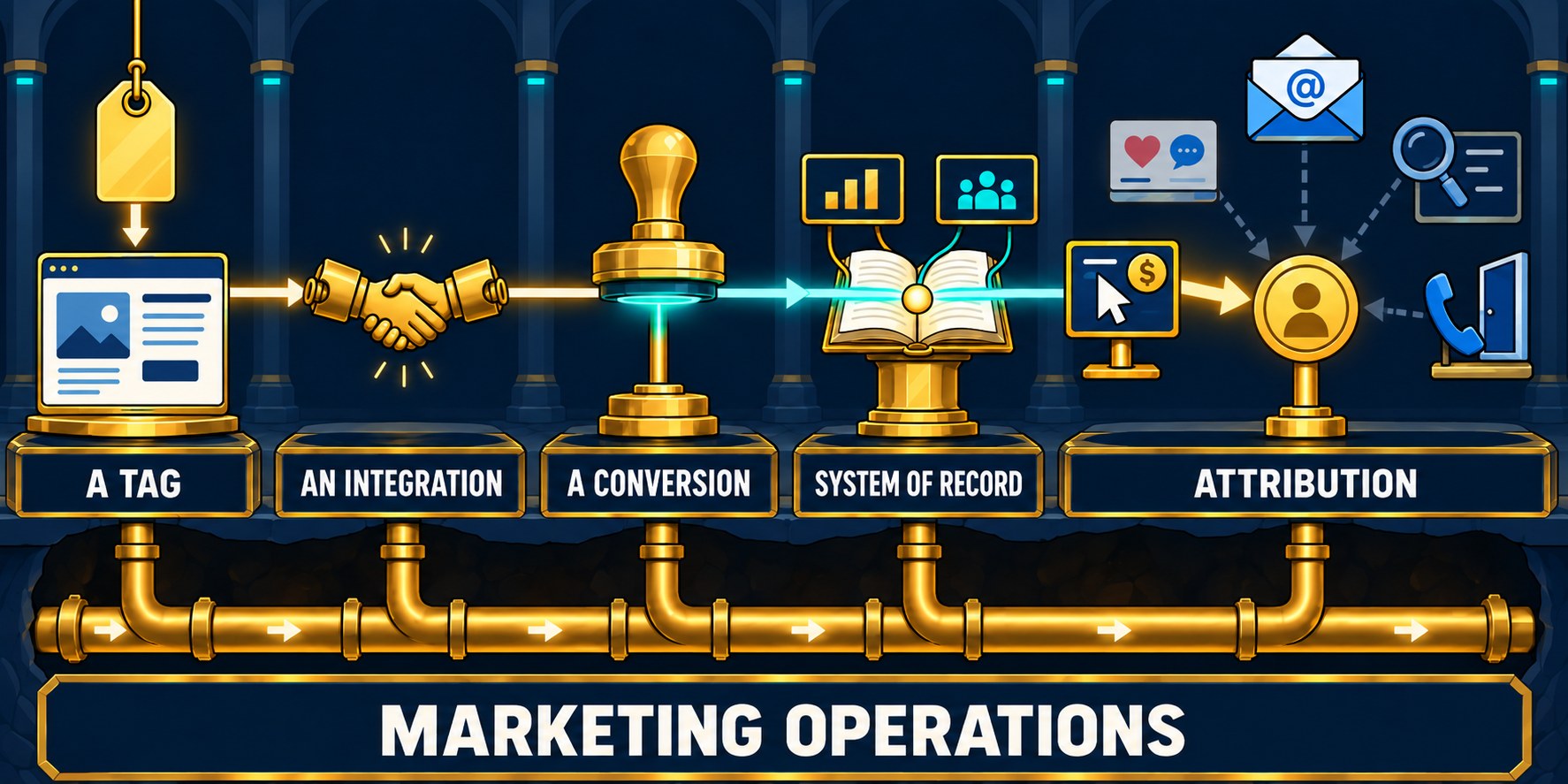
The role attracts jargon, and the jargon hides how ordinary the work is. Here is the plain version of each one.
| The word | What it actually means |
|---|---|
| Marketing operations | The plumbing behind the marketing, rather than the marketing. |
| Attribution | Which of the five people who touched the sale gets the credit. |
| System of record | The one place that is allowed to be right when two screens disagree. |
| A conversion | The word you chose to mean success. Everyone inherits your choice. |
| An integration | A handshake between two tools that nobody is watching. |
| A tag | A small script that reports what happened, and can report it wrong. |
Hire it, buy it, or become it
Three real answers, and the third one is genuinely real. The trait that makes somebody good at this is not tooling knowledge, which is learnable in a few months. It is a willingness to check a number that everybody already believes. If you have somebody like that on staff, you have most of it already.
If you do not, you can rent it, and you should. Ask whoever you rent it from to write the sentence down somewhere you can read it without them. An interpreter you cannot check is not an interpreter. That is just somebody who owns your meaning.
Questions people ask
What is a technical marketing manager?
The same role with a people-management line added. The work below is unchanged: own the sentence that says what a number means, and hold two departments to it. A manager title tells you who reports to whom. Ask instead who answers for whether the number is true.
What does technical marketing do?
It makes the marketing measurable and the measurement arguable by two departments at once. On an ordinary day that is a tracking snippet, a definition nobody agreed on, and an integration that stopped without telling anyone. It is not writing about the product, which is a different job that shares the name.
What do people in marketing do all day?
The marketing half is campaigns, copy, creative and channels. This role does almost none of that. It spends the day underneath it, on the plumbing that decides whether the campaign can be judged at all, which is why it is so easy to hire for badly. If it is the writing you need, that is a different service: content marketing.
Does tech marketing pay well?
It pays above general marketing, and that is the wrong question if you are the one hiring. The number worth knowing is what it costs you to NOT have it: a tag that double counts trains your ad spend on a fiction, and nobody sends you an invoice for that.
Is this the same as a marketing operations manager?
Mostly, and the titles are used interchangeably enough that you should read the duties rather than the name. The useful distinction is not the title, it is whether the person is accountable for whether a number is true, or only for producing it.
Can I just train someone I already have?
Often, and it is usually cheaper. The trait that matters is not tooling knowledge, which is learnable, it is a willingness to check a number that everyone already believes. If you have somebody like that, the tools are a few months of work.
We use an agency. Is that not what we pay them for?
Sometimes, and it is worth asking directly. Agencies are usually accountable for the campaign, not for the measurement layer underneath it, and the two are often separated in the contract without anyone noticing. Ask who is responsible when the number is wrong.
What if I answered the five questions and I am somewhere in the middle?
Then you do not need a hire, you need those five answers written down where the next person can find them. Set a date ninety days out to check whether they are still true, because a stack changes faster than the document describing it.